Wing Chun From
the Ground Up.
Wing Chun Boot Camp™ is where training begins at West Coast Wing Chun.
For twelve weeks, students train Siu Lim Tao, Wing Chun techniques and movement, Qi Gong, theory, and partner application. Each part develops alongside the others as the course progresses.
No previous martial arts experience is required.
FIND WING CHUN BOOT CAMP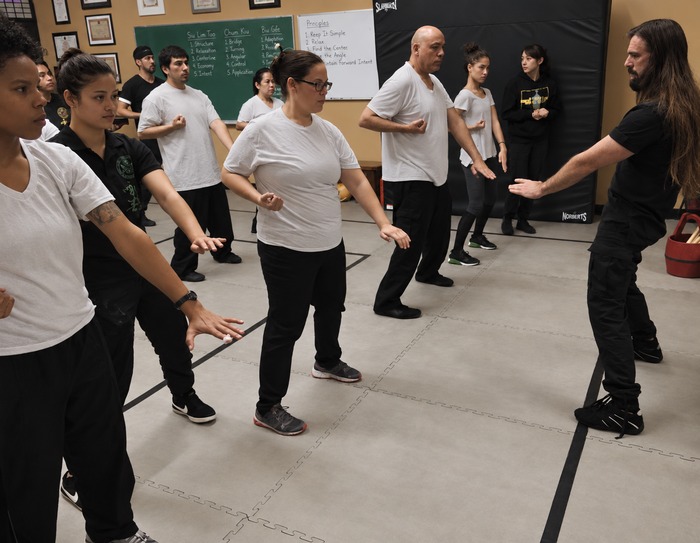
Five Parts. Taught Together.
Boot Camp combines form, physical training, Qi Gong, theory, and work with another person throughout the twelve weeks.
Siu Lim Tao
Every Boot Camp class includes the complete Siu Lim Tao form. Students return to it throughout the twelve weeks, receiving corrections and developing their understanding as the course progresses.
Technique & Movement
This is the physical group training: punches, Pak Da, Tan Da, Biu Sau and other fundamental techniques trained through high repetition, along with stance, footwork and kicks.
As students progress, hands and feet are combined and the work becomes more demanding. You do not need to arrive fit. Fitness develops through the training.
Qi Gong
Qi Gong is part of the Boot Camp curriculum, with breath training and focused practice taught alongside the physical work.
Theory
Classes include Wing Chun history, lineage and terminology, along with principles such as timing, relaxation, facing, centerline, economy, continuous motion, targeting, fighting zones and sensitivity.
Partner Training
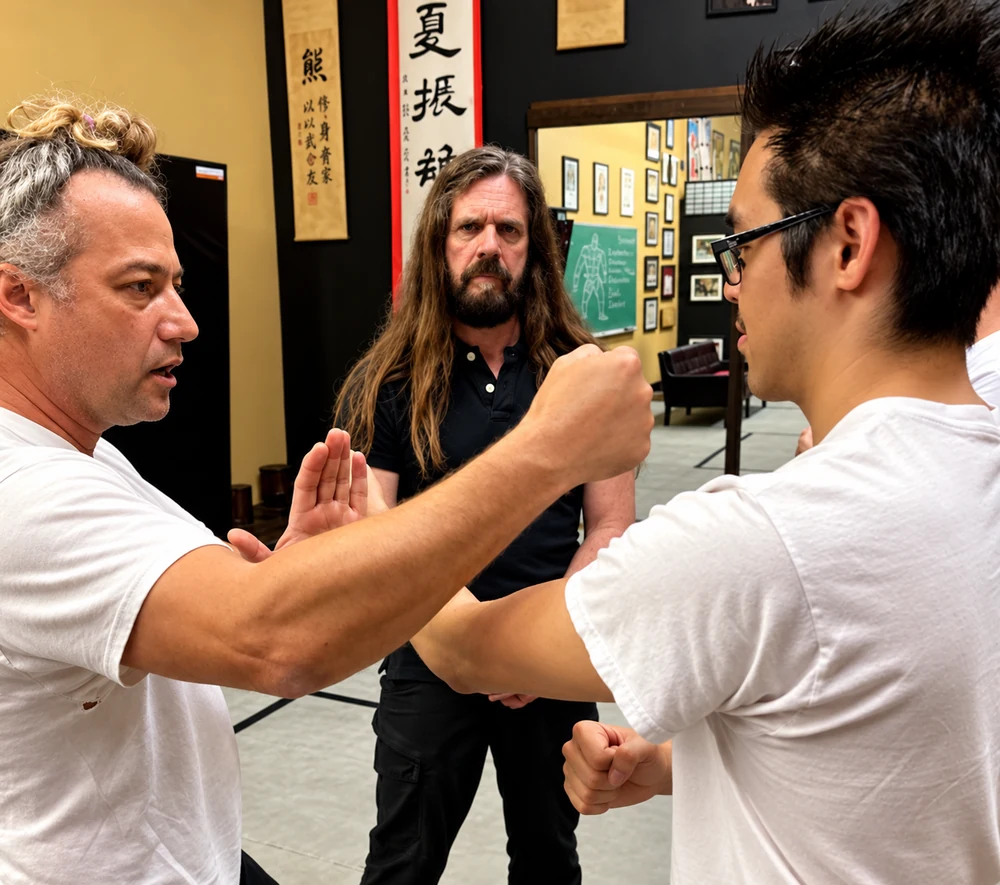
Students work with another person through defensive and attacking combinations, Defense Cycles, Six Gates, Dan Chi Sau, sensitivity and basic trapping. Distance, timing and another person’s movement change the work again.
Do It Again.
Now Do More With It.
Repetition is a major part of Boot Camp, but repetition does not mean staying in one place.
A class may include hundreds of repetitions of Pak Da or Tan Da, or a thousand punches. The student keeps moving forward while returning to material already learned.
Pak Da may first be practiced as an individual technique. Later it appears in the Defense Cycle. Footwork is added. Timing matters. Then a partner changes the distance and gives the movement something to respond to.
The student hasn’t stopped progressing in order to perfect Pak Da first. Pak Da has progressed with the student.
The Course Builds on Itself.
Earlier material stays in the training as new material is introduced. By the later classes, students are working with movements and ideas that first appeared weeks earlier in increasingly connected ways.
Build the Foundation
Connect the Material
Work With Application
+ SIU LIM TAO EVALUATION
The Material Changes as You Do.
The fundamentals introduced early in Boot Camp continue to appear throughout the course. What changes is what the student is asked to do with them.
Structure is connected to movement. Movement is connected to footwork. Techniques are combined. Timing and distance become part of the problem. Then another person is added.
And Yes, There Are Tests.
Students are expected to understand what they are learning as well as train it physically.
Quiz 1
Written assessment of the terminology and concepts taught during the first part of the course.
Quiz 2
A second written assessment as additional Wing Chun principles and applications are introduced.
Final Evaluation
A final written examination and final evaluation of the Siu Lim Tao form practiced throughout Boot Camp.
When Can I Start?
Wing Chun Boot Camp™ is a twelve-week course, but WCWC schools do not all run it on identical calendars.
Some locations offer dedicated Boot Camp classes or specific start dates. Others allow a new student to enter during an existing cycle and work through the material from that point.
What Happens
After Boot Camp?
Boot Camp is the first course in the West Coast Wing Chun curriculum.
The form, movements and principles introduced during these twelve weeks continue to develop as students progress through Siu Lim Tao, Chum Kiu, Biu Gee, Wooden Dummy, Long Pole, Bot Cham Do, and later application and pressure training.
EXPLORE THE CURRICULUMFind Wing Chun Boot Camp.
Contact the WCWC location nearest you for current Boot Camp scheduling, enrollment, and pricing.
You Can Still Train With WCWC.
Private online Wing Chun instruction is available for students who do not live near a West Coast Wing Chun school or training group.
EXPLORE ONLINE TRAININGQuestions About Starting.
How long is Wing Chun Boot Camp?
Wing Chun Boot Camp™ is a twelve-week course.
Do I need previous martial arts experience?
No. Boot Camp is where new WCWC students begin.
Do I need to be physically fit before I begin?
No. Students begin at different levels of conditioning. Physical fitness develops through the training itself.
Do I have to wait for a new twelve-week course to start?
Not necessarily. Scheduling varies by location. Some schools use defined start dates, while others bring new students into an existing cycle.
Do students practice the complete Siu Lim Tao form?
Yes. The complete Siu Lim Tao form is practiced throughout Boot Camp and evaluated at the end of the course.
Are there tests?
Yes. Boot Camp includes quizzes at Classes 4 and 8, followed by a final written examination and Siu Lim Tao evaluation in Class 12.